
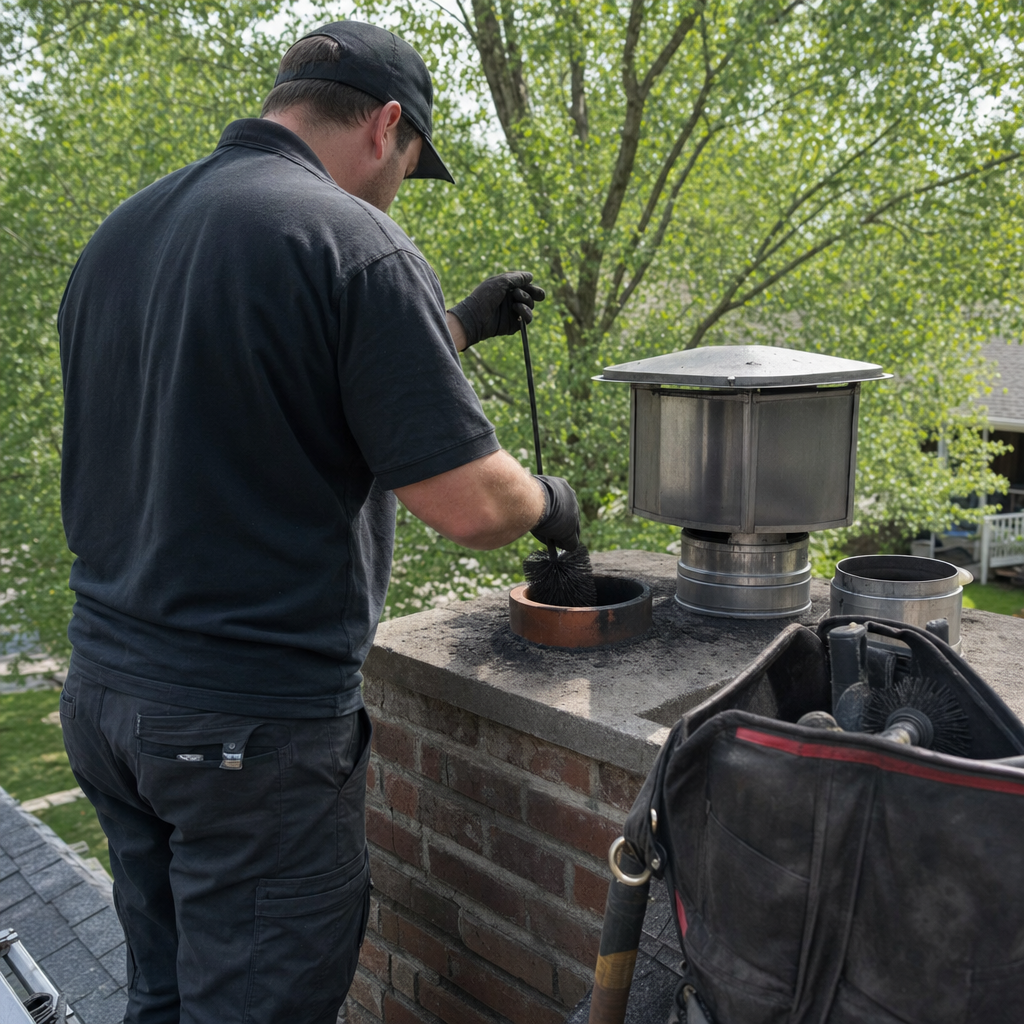
Chimney Flashing Repair in Knoxville, TN — What Your Roofer Won’t Catch
Chimney flashing repair in Knoxville typically runs $450–$1,200 depending on whether you’re dealing with counter flashing seated in masonry or step flashing woven into shingles, and most jobs we handle are completed in a single visit. If you’re seeing water stains on the ceiling near your fireplace or noticing rust streaks where the chimney meets the roofline, call (877) 318-5851 — Charles handles the diagnostic personally, and estimates are free.

Here’s the straight talk we’ve learned over 17 years on Knoxville rooftops: by the time flashing failure shows up as a wet spot on your ceiling, the leak has already been active for one or two winters. In Sequoyah Hills, Fourth & Gill, and Old North Knoxville — neighborhoods we work weekly — we’ve pulled apart flashing jobs that roofers “fixed” with fresh caulk, only to find the clay flue liner behind it cracked from freeze-thaw damage and the mortar bed saturated. Your roofer can reseal the flashing. What he can’t tell you is whether the two winters of moisture that got through it already cracked your flue liner. That’s why chimney flashing repair in Knoxville is almost never a roofing job first — it’s a chimney specialist’s diagnosis with a roofing detail attached.
Why Knoxville’s Climate Destroys Flashing Differently Than Other Markets
Knoxville sits in the Tennessee Valley basin where winter temperatures oscillate constantly around the freezing mark rather than holding steady cold. That aggressive freeze-thaw cycling fractures mortar joints at the chimney-roof intersection faster than in deeper-South cities like Atlanta or Charlotte. Meanwhile, the Tennessee River and its TVA impoundments keep ambient humidity elevated year-round, so when gaps open in flashing or mortar, moisture drives in persistently rather than drying out.
The failure sequence we see repeatedly in Knoxville goes like this:
- Freeze-thaw cycling fractures mortar where the chimney meets the roofline
- Gaps open between counter flashing and masonry, or step flashing lifts from shingle movement
- Knoxville’s wet winters drive water into the gap — often invisibly at first
- Water tracks down the exterior of the flue, inside the chimney chase or behind the firebox
- Visible water staining or ceiling damage appears — typically after the second season of leakage
- By this point, the flashing repair is the last step, not the first
In the historic masonry chimneys of Fourth & Gill and Old North Knoxville — many built in the 1890s to 1920s with original clay flue tiles — this moisture infiltration often finds deteriorated parging or fully unlined flues that predate modern IRC standards. The water that got past your flashing didn’t just stain drywall; it may have accelerated spalling in the brick face, degraded the flue liner, or saturated the smoke chamber. A roofer patching the flashing without assessing the chimney-side damage guarantees a return call — sometimes for a much more expensive problem.
We’ve also noticed a pattern in the exurban communities north of Knoxville — Powell, Corryton, and the Norris Lake corridor — where homeowners with wood-burning fireplaces harvest their own firewood from surrounding timber tracts and burn it before it properly seasons. The resulting heavy fires produce more acidic condensation at the flue exterior, which accelerates corrosion where galvanized flashing meets masonry. It’s a compounding factor that technicians from flatter, more suburban markets wouldn’t anticipate.
Counter Flashing vs. Step Flashing: Which One Is Actually Failing?
Homeowners call us saying “my flashing is leaking,” but there’s a critical distinction that determines who should do the repair — and whether it’ll last.
Step flashing consists of individual L-shaped metal pieces woven into each course of shingles and bent up against the chimney. When step flashing fails, it’s usually because shingles have lifted, the metal has corroded through, or a previous roofer relied on surface sealant instead of proper weaving. This is legitimately roofing trade work, and a competent roofer should handle it.
Counter flashing is the piece that’s cut into the masonry joint (the reglet) and folded down over the step flashing. It’s what you actually see from the ground — a metal cap sealing the top of that intersection. When counter flashing fails, the problem is in the masonry: the reglet has opened, the caulk has hardened and cracked, or the metal has pulled away from the brick due to mortar deterioration. Repairing this requires cutting a clean reglet into sound masonry, properly seating new counter flashing, and sealing with materials compatible with both metal and masonry — not just squirting roof caulk over the gap.
This is why counter flashing failure is a chimney repair job, not a roofing job. We’ve seen roofers in Knoxville caulk over deteriorated counter flashing three times on the same chimney because they don’t carry the masonry tools or the chimney-specific knowledge to do the underlying fix. After the third callback, the homeowner finally calls us, and we find the mortar behind that caulk has turned to sand and the flue liner has a vertical crack from years of thermal shock compounded by moisture infiltration.
Charles Rodriguez, our owner and lead technician, grew up in Sequoyah Hills and trained through Pellissippi State’s Building Construction Technology program before spending years on real Knoxville chimneys. He’s become the guy neighbors call when another company has already missed something — and flashing callbacks are one of the most common “misses” we inherit.
What a Complete Flashing Repair Looks Like on a Knoxville Historic Chimney
There’s a meaningful difference between what we do and what passes for “flashing repair” from a generalist. Here’s the actual scope when Charles handles a counter flashing repair on a masonry chimney in Knoxville:
| Repair Component | Typical Cost Range |
|---|---|
| Remove deteriorated caulk and existing counter flashing | Included in base |
| Cut clean reglet (masonry joint) to proper depth | $450–$650 |
| Fabricate and install new copper or galvanized counter flashing | $200–$400 |
| Seal reglet with professional-grade masonry sealant | Included in base |
| Inspect flue interior and crown for moisture damage | $0–$150 (often bundled) |
| Repair minor crown cracking (if found) | $180–$350 |
| HeatShield flue liner resurfacing (if moisture damage found) | $800–$1,500 |
| Typical total for complete flashing repair with diagnostic | $450–$1,200 |
Compare that to the “repair” we commonly find preceding our calls: surface caulk-over-existing that lasts one season, costs $150–$300, and leaves the underlying masonry deterioration untouched. The homeowner pays twice — sometimes three times — before getting the actual fix.
On historic chimneys in Knoxville’s older neighborhoods, we also encounter a specific problem: original counter flashing was often lead, which oxidizes and cracks over decades, or was never properly reglet-set at all — just bent over the brick and caulked. In these cases, we use Olympia Chimney and Gelco components where appropriate for cap and crown integration, and fabricate custom counter flashing to match the chimney’s dimensions rather than forcing stock pieces that don’t seat properly.
The Diagnostic Step Roofing Contractors Skip
After any flashing repair on a chimney that has been leaking, we inspect two areas that roofers simply don’t have the equipment or training to assess:
The flue interior. Using a chimney camera, we run the full length of the flue to check for cracks, spalling, or gaps between flue tiles that moisture infiltration may have worsened. In Knoxville’s climate, a cracked flue liner is a carbon monoxide and creosote intrusion risk — not a theoretical concern, but a genuine safety issue we’ve documented repeatedly in homes where flashing leaked for multiple seasons.
The crown surface. The concrete or mortar cap at the top of the chimney is the first line of defense against water entering the chimney structure. Knoxville’s humidity and freeze-thaw cycling make crown cracking a near-universal finding on homes over 30 years old. If the crown is deteriorated, water will continue entering the chimney structure even after flashing is repaired — undermining the repair from above while the homeowner thinks the problem is solved.
This is the core advantage of how Titan operates: because Charles handles both the flashing repair and the associated chimney-side masonry assessment in a single visit, homeowners don’t pay a roofer to do half the job and then call us back to do the other half. We use HeatShield for flue liner resurfacing when moisture damage is found, and Famco components where ventilation and cap integration are part of the solution — professional-grade materials, not hardware-store workarounds.
A clean chimney isn’t a luxury — it’s just what stands between your fireplace and your ceiling.
How Do You Know It’s Flashing and Not Something Else?
Not every leak near a fireplace is flashing failure. Before you call anyone, here are the diagnostic clues Charles looks for on a Knoxville roof:
- Water stains on the ceiling follow the chimney’s footprint — typically triangular or rectangular, directly adjacent to the masonry
- Rust streaks or green oxidation on the metal where chimney meets roof — visible from ground level with binoculars
- Staining appears after rain but not during heavy wind from a specific direction — suggests cap or crown issue instead
- The leak is worse during Knoxville’s freeze-thaw periods (February–March, November–December) — classic expansion-contraction failure
- Previous “repair” was caulk-only and lasted less than 18 months — indicates the underlying reglet or masonry was never addressed
If you’re seeing these patterns, the repair likely needs a chimney specialist’s assessment before any metal gets replaced. Call (877) 318-5851 and Charles will walk you through what he’s seeing — or schedule a free estimate if you want eyes on it.
FAQs
Chimney flashing repair in Knoxville typically costs $450–$1,200 for a complete counter flashing repair including reglet cutting, new metal installation, and masonry sealing. Surface caulk-only “repairs” run $150–$300 but usually fail within a season. Call (877) 318-5851 for an exact quote — estimates are free.
Repair is almost always cheaper if caught early — $450–$650 for reglet repair and counter flashing replacement versus $1,500–$3,000+ for full chimney rebuild if moisture infiltration has destroyed the masonry behind it. The problem is that Knoxville’s wet winters and freeze-thaw cycling accelerate hidden damage quickly, so delaying repair often forces replacement. We inspect the flue and crown during every flashing estimate to tell you which category you’re in.
Most straightforward counter flashing repairs in Knoxville are completed in a single visit of 3–4 hours. If we find flue liner damage or crown deterioration during the diagnostic, we’ll show you the camera footage and schedule the additional work — we don’t surprise you with scope changes after starting. Same-day availability depends on our current schedule; call (877) 318-5851 and we’ll get you the next open slot.
Call a chimney company first if the metal is seated in masonry (counter flashing), if the chimney is historic masonry, or if you’ve had any previous leak. Call a roofer only if the issue is step flashing woven into shingles with no masonry involvement. In Knoxville’s historic neighborhoods — Fourth & Gill, Old North Knoxville, Sequoyah Hills — the chimneys are almost exclusively masonry with counter flashing, making this a chimney specialist’s job. We’ve inherited dozens of callbacks from roofers who patched the symptom while the structural problem progressed.
What Happens If You Wait on Flashing Repair in Knoxville
We get it — chimney flashing doesn’t feel urgent until water is dripping on your floor. But in this market specifically, waiting carries amplified risk. Knoxville’s humidity means moisture doesn’t dry out between wet periods; it accumulates. The freeze-thaw cycling means every winter widens gaps that were hairline cracks in autumn. And the prevalence of wood-burning fireplaces in this city means many homeowners are actively using a chimney system while it’s compromised — drawing combustion gases through a flue that may have hidden moisture damage.
Nearly 1,200 homeowners have reviewed us across 17 years of chimney-only work, and the pattern we see in negative reviews of other companies (not ours — our 4.9-star average reflects consistent execution) is almost always the same: delayed flashing repair led to liner damage, which led to a $2,000+ rebuild that could have been a $600 fix two years earlier.
Charles handles every job personally. You get the most experienced person on your roof, not an apprentice dispatched by a franchise. From basic sweeps to full liner rebuilds using professional-grade materials, we handle the full chimney system under one roof — no referrals out, no gaps in scope.
Ready to stop the leak for good? Call (877) 318-5851 for a free estimate on chimney flashing repair in Knoxville. Charles will assess the flashing, inspect the flue and crown for hidden moisture damage, and give you a straight answer on what it takes to fix it right — not just patch it over.
Written by Charles Rodriguez, Owner & Lead Technician at Titan Chimney Cleaning Service Knoxville, serving Knoxville, TN.