
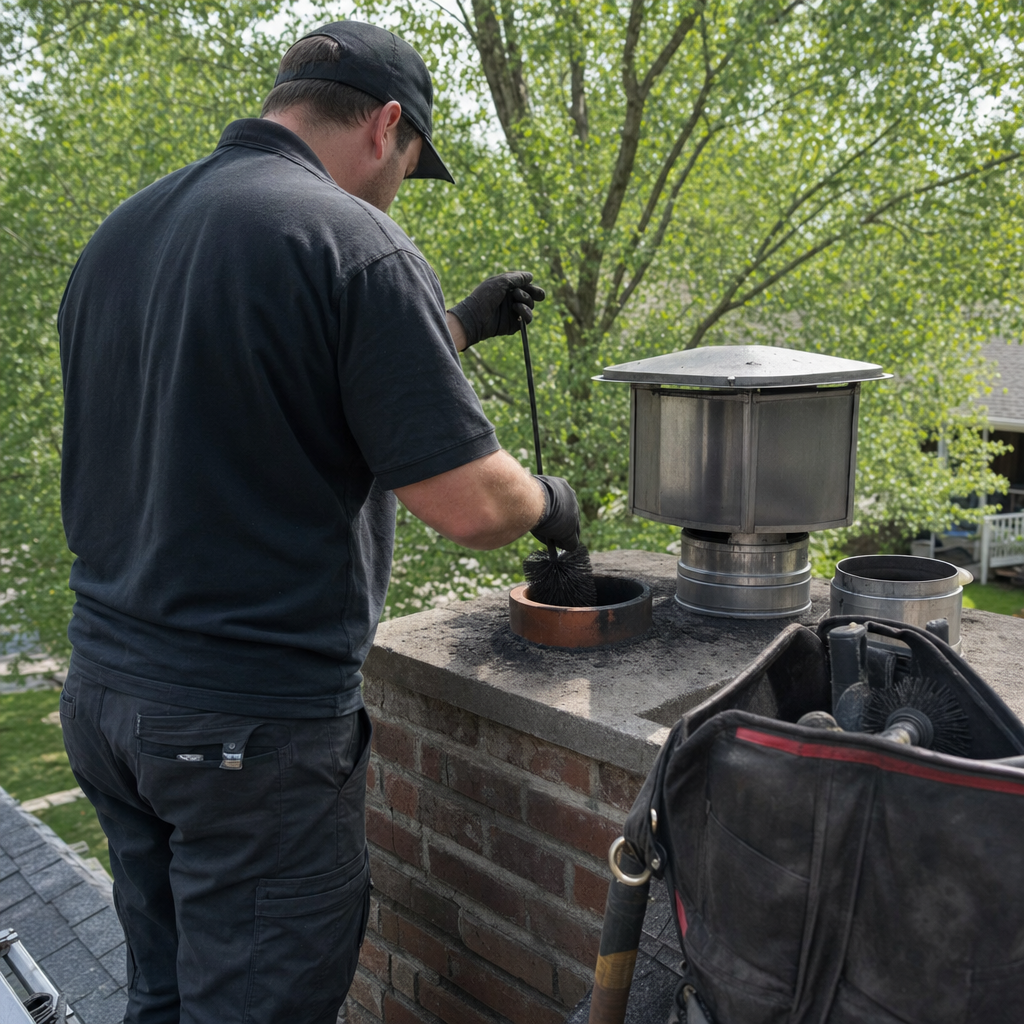
Chimney Cleaning Cost in Knoxville: What You’ll Actually Pay Based on How You Burn
A standard chimney sweep in Knoxville runs between $175 and $325, but if you’re burning self-harvested hardwood from the Appalachian timber tracts north of the city, the real question isn’t yearly cost—it’s cost per cord burned. Call (877) 318-5851 for a free estimate on your specific setup.

Last February, we got a call from a homeowner in Powell who’d burned three cords of mixed oak and hickory he’d cut himself the previous spring. The chimney looked fine from the hearth. Up on the roof, the flue told a different story: glazed creosote so thick it reduced the opening by nearly 40 percent. A basic brush-and-vac sweep would’ve been useless. What he needed was chemical rotary cleaning, and that changed the price by more than a hundred dollars. This isn’t rare in the Powell-to-Norris Lake corridor—it’s the pattern we plan for.
Why Cord-Burned Cost Matters More Than Calendar Cost in Knoxville
Most chimney companies price by the visit: one sweep per year, regardless of use. That model works fine for a gas fireplace in Sequoyah Hills that gets lit twice a month for atmosphere. It falls apart for homeowners in Corryton or north of Norris Lake who heat with wood four or five nights a week through Knoxville’s freeze-thaw winters.
Here’s the professional rule of thumb we use: one inspection for every two cords of hardwood burned, not one per calendar year. Appalachian mixed hardwood—especially when self-harvested and under-seasoned—deposits glazed creosote at a rate that can condemn a flue in a single heating season. The Tennessee Valley’s humidity doesn’t help. Moisture from green wood hits the cooler upper flue, condenses, and bakes into that glassy, jet-black Stage 3 buildup that standard brushes won’t touch.
We’ve seen homeowners try to stretch a “yearly” sweep across two or three cords. By the time they call, they’re often looking at more than cleaning: cracked flue tiles from thermal stress, deteriorated parging, or liner damage from sustained over-firing. The cost math still favors proper maintenance. A chemical rotary cleaning at $275–$425 beats a chimney fire claim by orders of magnitude, and it prevents the secondary damage that turns a sweep into a rebuild.
Charles Rodriguez, our owner and lead technician, grew up in Sequoyah Hills and learned the trade through Pellissippi State’s Building Construction Technology program before spending years on Knoxville rooftops. He’s the one who spots what others miss—creosote packed behind a damper, a cracked liner nobody documented, a bird nest so tight it’s a fire waiting to happen. When Charles handles a job personally, you’re getting 17 years of chimney-only experience, not a dispatched apprentice.
The Knoxville Geographic Fault Line: Stage 1 vs. Stage 3 Creosote
There’s a clear divide in what we find across Knoxville, and it maps directly to where your firewood comes from.
| Service Type | Typical Cost Range | Where We See It Most |
|---|---|---|
| Standard sweep (Stage 1–2 creosote, brush and vacuum) | $175 – $250 | Fourth & Gill, Sequoyah Hills, Old North Knoxville |
| Heavy-duty sweep (Stage 2–3, rotary power cleaning) | $225 – $325 | Fountain City, East Knoxville, mid-century ranch areas |
| Chemical rotary cleaning (Stage 3 glazed creosote) | $275 – $425 | Powell, Corryton, Norris Lake corridor |
| Level 2 inspection with video scan | $150 – $275 (often bundled with sweep) | Required for real estate transactions, insurance claims, or suspected damage |
| Chimney cap or crown repair (when found during cleaning) | $350 – $850 | Universal on homes 30+ years due to valley humidity and freeze-thaw cycling |
In-town Knoxville neighborhoods—Fourth & Gill, Sequoyah Hills, Old North Knoxville—we typically see Stage 1 to light Stage 2 creosote. These homeowners often buy kiln-dried or properly seasoned firewood, burn less frequently, and have chimneys that get regular attention. A standard sweep handles it.
Head north toward Powell, Corryton, and the Norris Lake corridor, and the picture changes. Homeowners with timber access harvest their own oak, hickory, and maple. If that wood doesn’t get 12–18 months of covered drying—and in our wet Tennessee Valley climate, it often doesn’t—it enters the fireplace at 25–30 percent moisture. The result is Stage 3 glazed creosote: hard, shiny, and chemically bonded to the flue liner. Try to brush over it with hardware-store equipment and you’ll polish it smooth without removing it. We’ve seen other companies do exactly that, leaving the homeowner with a false sense of security and a flue that’s still dangerous.
That’s why Titan uses professional-grade rotary systems and, when needed, chemical treatments from Copperfield and Famco to break down glazed buildup before mechanical removal. It’s slower work. It costs more. It also doesn’t leave a fire hazard behind.
What “Chimney Cleaning” Actually Includes (and What It Doesn’t)
Part of the confusion around chimney cleaning cost comes from the term itself. Homeowners hear “cleaning” and assume they’re getting a full system evaluation. They’re often not. Here’s the breakdown:
- Chimney sweep/cleaning: Removal of soot, creosote, and obstructions from the flue; basic visual inspection of accessible components. This is what the base price covers.
- Level 1 inspection: Visual examination of readily accessible portions of the chimney exterior and interior, plus the appliance and connection. Often included with a sweep, but confirm—some companies charge separately.
- Level 2 inspection: Video scan of the flue interior, examination of attics, crawl spaces, and other accessible areas. Required for real estate transactions, after chimney fires, or when changing appliance type. Typically $150–$275 additional.
- Repairs: Crown cracks, cap replacement, liner damage, mortar joint repointing—these are not cleaning and carry separate costs. Finding them during a cleaning is common; fixing them is a separate scope.
We always document what we find with photos and explain whether what we’re seeing is maintenance, wear, or an active safety issue. A clean chimney isn’t a luxury—it’s just what stands between your fireplace and your ceiling.
Knoxville’s historic housing stock complicates this further. Those late-19th and early-20th century masonry chimneys in Old North Knoxville and Fourth & Gill? Many still run original clay flue tiles, deteriorated parging, or fully unlined flues that predate modern IRC standards. A sweep on an unlined chimney isn’t the same job as a sweep on a modern stainless system, and pricing should reflect that. Mid-century ranch homes across East Knoxville and Fountain City bring their own issues: single-story fireplaces with undersized flues built for coal conversion, now struggling to vent wood smoke properly.
Why Professional-Grade Equipment Changes the Outcome
There’s a reason we don’t use hardware-store brushes on glazed creosote, and it’s not about upselling. Stage 3 buildup is hydrophobic and chemically altered by repeated heating. Standard polypropylene or wire brushes skate across the surface. What we need is rotary action—steel or chain whips driven by a high-torque drill at controlled speed, often paired with chemical modifiers that soften the glaze before mechanical removal.
When we install or repair liners, we use DuraFlex and HeatShield products, not generic alternatives. For caps and crowns, Gelco and Olympia Chimney components hold up better in Knoxville’s humidity and freeze-thaw cycling than the thin-gauge options that fail in three to five years. The upfront cost difference is modest. The replacement-cycle difference is significant.
We’ve been called in after other companies have “swept” a chimney that still had dangerous buildup because the technician didn’t recognize what they were looking at—or didn’t have the equipment to address it. With nearly 1,200 homeowners reviewing us at 4.9 stars, our pricing and our findings are publicly auditable. You can cross-reference what real Knoxville homeowners paid against what was found in their flue.
Knoxville’s Climate: The Hidden Cost Driver
Knoxville sits in the Tennessee Valley basin, ringed by Appalachian ridges that produce frequent atmospheric temperature inversions in fall and early winter. These inversions suppress chimney draft and cause smoke to back into homes far more often than in open-terrain cities. Homeowners respond by burning hotter, faster fires to force draft—exactly the conditions that produce the densest creosote.
Meanwhile, our winters oscillate around the freezing mark rather than holding steady cold. That aggressive freeze-thaw cycling spalls brick faces and fractures mortar joints faster than in deeper-South cities. The Tennessee River and TVA impoundments keep ambient humidity elevated year-round, driving moisture into chimney masonry. Crown cracking and cap failure are near-universal findings on Knoxville homes over 30 years old. We note these during cleaning because they affect how your chimney performs and what you’ll spend over its lifespan.
Charles handles these evaluations personally. There’s no apprentice learning on your roof, no franchise dispatcher guessing at scope. When you call Titan, you’re getting the same technician who’ll be up on your chimney, and he’s been doing this in Knoxville for 17 years.
FAQs
A standard chimney sweep in Knoxville typically costs $175 to $250 for Stage 1–2 creosote, while heavy glazed buildup requiring chemical rotary cleaning runs $275 to $425. Homes in Powell, Corryton, and the Norris Lake corridor more often fall into the higher range due to self-harvested, under-seasoned hardwood. Call (877) 318-5851 for an exact quote—estimates are free.
Repair is usually cheaper if the damage is localized—HeatShield resurfacing or a stainless DuraFlex liner insert typically runs $1,200 to $3,500 versus $4,000 to $8,000+ for full reconstruction. We determine this with a video scan during your Level 2 inspection, which we can bundle with your cleaning. The key is catching liner damage before it compromises the surrounding masonry.
We offer same-day and next-day scheduling for urgent situations—smoke backup, suspected blockage, or post-chimney-fire evaluation—and we carry the equipment to handle Stage 3 glazed creosote on the spot. Call (877) 318-5851 and we’ll get you on the schedule; emergency appointments are prioritized but priced at standard rates, not inflated.
If you’re burning wood that hasn’t been split, stacked, and covered for at least 12 months in Knoxville’s humid climate, or if you harvest from local timber tracts and burn the same season, you’re almost certainly producing glazed creosote faster than a standard yearly sweep can manage. The telltale signs: black, shiny flue deposits; reduced draft; or a tar-like odor when the fireplace isn’t in use. We can test wood moisture content during your visit and advise on seasoning.
Ready to Know What Your Chimney Actually Needs?
Don’t guess at your chimney cleaning cost based on a national average that doesn’t account for Knoxville’s humidity, your firewood source, or your home’s specific flue condition. Charles Rodriguez will evaluate your system personally, explain what we find without jargon, and give you upfront pricing before any work begins. Call (877) 318-5851 today for your free estimate.
Written by Charles Rodriguez, Owner & Lead Technician at Titan Chimney Cleaning Service Knoxville, serving Knoxville, TN.