
What Is Creosote Buildup? A Knoxville Homeowner’s Guide to the Three Stages
Creosote buildup is the accumulation of tar-like combustion byproducts that coat the inside of your chimney flue when wood or fossil fuels burn incompletely. It forms in three distinct stages — from fluffy, brushable soot to hard, glazed deposits that can ignite at temperatures above 450°F and burn hot enough to crack clay flue liners or penetrate masonry gaps. In Knoxville, the combination of abundant Appalachian hardwood, a strong culture of self-harvested firewood in our northern exurbs, and the Tennessee Valley’s temperature inversions pushes many local chimneys toward Stage 3 glazed creosote faster than flatland markets where we used to work.

We’re Charles Rodriguez and the team at Titan Chimney Cleaning Service Knoxville. Over 17 years of working Knoxville rooftops — from the historic masonry chimneys of Fourth & Gill to the exurban homes around Norris Lake — we’ve learned that creosote isn’t just a chemistry problem. It’s a local conditions problem. The same fireplace burning the same wood species will produce different creosote at different rates depending on your elevation, your firewood source, and whether the valley’s atmospheric inversion is suppressing your draft that week.
A clean chimney isn’t a luxury — it’s just what stands between your fireplace and your ceiling. Here’s what Knoxville homeowners actually need to understand about creosote, why our market produces it aggressively, and what each stage means for your safety and your wallet.
How Creosote Forms: The Basics Every Homeowner Should Picture
When wood burns, it doesn’t burn completely. The volatile compounds that don’t fully combust — tars, hydrocarbons, moisture vapor, and carbon particles — rise with the exhaust gases up your flue. As these gases cool against the liner walls, they condense. That condensed material is creosote.
The critical factor is temperature. A hot, fast-burning fire with dry wood and strong draft keeps flue gases above 250°F all the way up, minimizing condensation. A smoldering fire with wet wood and weak draft lets gases linger below 200°F, and that’s when creosote deposits multiply. Think of it like breath on a cold window: the bigger the temperature difference and the slower the air moves, the more condensation forms.
In Knoxville, we see the worst creosote accumulation in three specific scenarios: homeowners burning self-harvested oak or hickory that hasn’t dried the full 12–18 months our dense Appalachian hardwoods require; fireplaces in the Tennessee Valley basin during inversion events when cold air gets trapped under warm air and suppresses natural draft; and older homes in Sequoyah Hills or Old North Knoxville with original clay flue tiles that stay cooler than modern liners, accelerating condensation.
The Three Stages of Creosote: What Each One Looks, Feels, and Acts Like
Not all creosote is the same. We’ve found that explaining the stages in physical terms — what you’d see if you shined a light up your own flue — helps homeowners understand why Stage 1 cleaning costs one price and Stage 3 removal costs something else entirely.
Stage 1: Soot and Fine Ash
Stage 1 creosote looks like black or dark brown dust, sometimes with a slightly oily sheen but still loose and powdery. It brushes off easily with a standard chimney sweep brush. It smells like a campfire, not sharp or chemical. If you touched it — which we don’t recommend without gloves — it would come off on your fingers like soot from a candle jar.
This is normal, expected accumulation from any wood-burning season. A standard Chimney Cleaning & Sweep in Knoxville removes it completely. Most Knoxville homeowners who burn seasoned hardwood and get annual sweeps never progress past Stage 1.
Stage 2: Crunchy, Flaky Deposits
Stage 2 creosote has begun to polymerize — the tars have started binding together into harder, more cohesive layers. It looks like shiny black flakes or crisp, brittle sheets adhering to the flue wall. When we scrape it with a metal tool, it breaks away in chunks rather than dusting off. It smells sharper, more acrid.
This stage forms when flue temperatures run consistently low: wet wood, restricted air intake, or poor draft. In Knoxville, we find Stage 2 most often in mid-century ranch homes across Fountain City and East Knoxville where original coal-conversion flues are undersized for modern wood inserts, creating chronic draft problems. Stage 2 still responds to mechanical brushing, though it takes longer and requires more aggressive tools than Stage 1.
Stage 3: Glazed, Hardened Creosote
Stage 3 creosote is the one that keeps us up at night. It looks like black or dark brown glass — smooth, hard, and enamel-like. It can be anywhere from a thin varnish to a thick, dripping coating that narrows your flue opening. It does not brush off. We’ve seen technicians spend an hour with a standard brush on Stage 3 and barely change its appearance. It smells sharp and chemically distinct, and it’s the most dangerous form by a significant margin.
Here’s why: Stage 3 glazed creosote ignites at approximately 450°F, compared to 1,000°F+ for plain wood. Once ignited, it burns at temperatures exceeding 2,000°F — hot enough to crack clay flue tiles, melt mortar, and transfer ignition to surrounding framing through gaps in deteriorated masonry. A chimney fire with Stage 3 fuel doesn’t behave like a controlled fireplace fire. It behaves like a blowtorch inside a confined tube.
In the exurban communities north of Knoxville — Powell, Corryton, and the Norris Lake corridor — we routinely find chimneys choked with heavy glazed creosote because homeowners harvest their own firewood from surrounding timber tracts and burn it before it seasons. Moisture content in self-harvested wood often runs 30–50% versus the 20% maximum for properly seasoned fuel. That moisture doesn’t just make fires harder to start; it keeps combustion temperatures low for the entire burn cycle, accelerating the progression from Stage 1 to Stage 3 in a single season rather than over several years.
Why Knoxville’s Geography Makes Stage 3 Creosote More Common Here
We’ve worked chimney markets in flatter terrain — places without Knoxville’s specific topography. The difference is stark. Knoxville sits in the Tennessee Valley basin, ringed by Appalachian ridges including Sharp’s Ridge to the north and the Cumberland Plateau escarpment to the northwest. These landforms produce frequent atmospheric temperature inversions in fall and early winter, especially during clear, calm nights when cold air pools in the valley and warm air sits above it.
During an inversion, your chimney’s natural draft is suppressed. The temperature differential that pulls exhaust upward diminishes. Flue gas velocity slows. Gases that should exit in seconds linger for minutes, cooling against liner walls and condensing their creosote load more aggressively. We’ve had weeks in November where inversion conditions produced Stage 2 accumulation in fireplaces that normally stay at Stage 1 all season.
This is the three-factor Knoxville environment that accelerates creosote progression:
- Appalachian hardwood density: Oak, hickory, and maple from local timber tracts burn hot and long when seasoned, but their density means they require 12–18 months of drying versus 6–9 months for softer species. Homeowners who harvest in spring and burn in fall are burning wet wood.
- Self-harvested firewood culture: In Powell, Corryton, and the Norris Lake corridor, the norm is cutting your own. The convenience of “free” wood from your property overrides the patience required for proper seasoning. Moisture meters are rare; visual checks (“it looks dry”) are common and unreliable.
- Valley inversions suppressing draft: The same geographic bowl that makes Knoxville beautiful in autumn makes our chimneys perform worse during peak burning season. Slower gas velocity equals more condensation equals faster stage progression.
Technicians from open-terrain suburban markets — think the flat exurbs of Atlanta or Charlotte — simply don’t encounter this rate of Stage 3 formation. They don’t train for it at the same frequency. We’ve been called to Knoxville homes where out-of-market sweeps brushed annually, declared the chimney clean, and left glazed deposits that we later measured at a quarter-inch thick. Standard brushes don’t remove Stage 3. That requires a different approach entirely.
Removing Stage 3 Creosote: Why Standard Sweeping Isn’t Enough
We need to be direct about this because homeowner safety depends on it. If a technician brushes your chimney, shows you a pile of black dust, and declares the job done — but your flue still has glazed, glassy deposits — you have not received a complete cleaning. You’ve received a Stage 1 cleaning on a chimney that needed Stage 3 remediation.
Stage 3 glazed creosote removal requires a two-step process. First, we apply a professional-grade chemical creosote modifier that penetrates the glaze and breaks down its polymerized structure over a controlled reaction period — typically 24 hours to two weeks depending on product concentration and deposit thickness. These aren’t hardware-store fireplace logs with vague claims. We use chemical treatments from the Copperfield and Olympia Chimney supply lines, formulated specifically for glazed deposit breakdown.
Second, after the chemical reaction has softened and fractured the glaze, we deploy a rotary mechanical cleaning system — a powered whip or chain system on flexible rods that physically abrades the treated deposits. This is not a standard brush. It’s a more aggressive, more time-intensive process that requires experienced operation to avoid damaging the liner underneath.
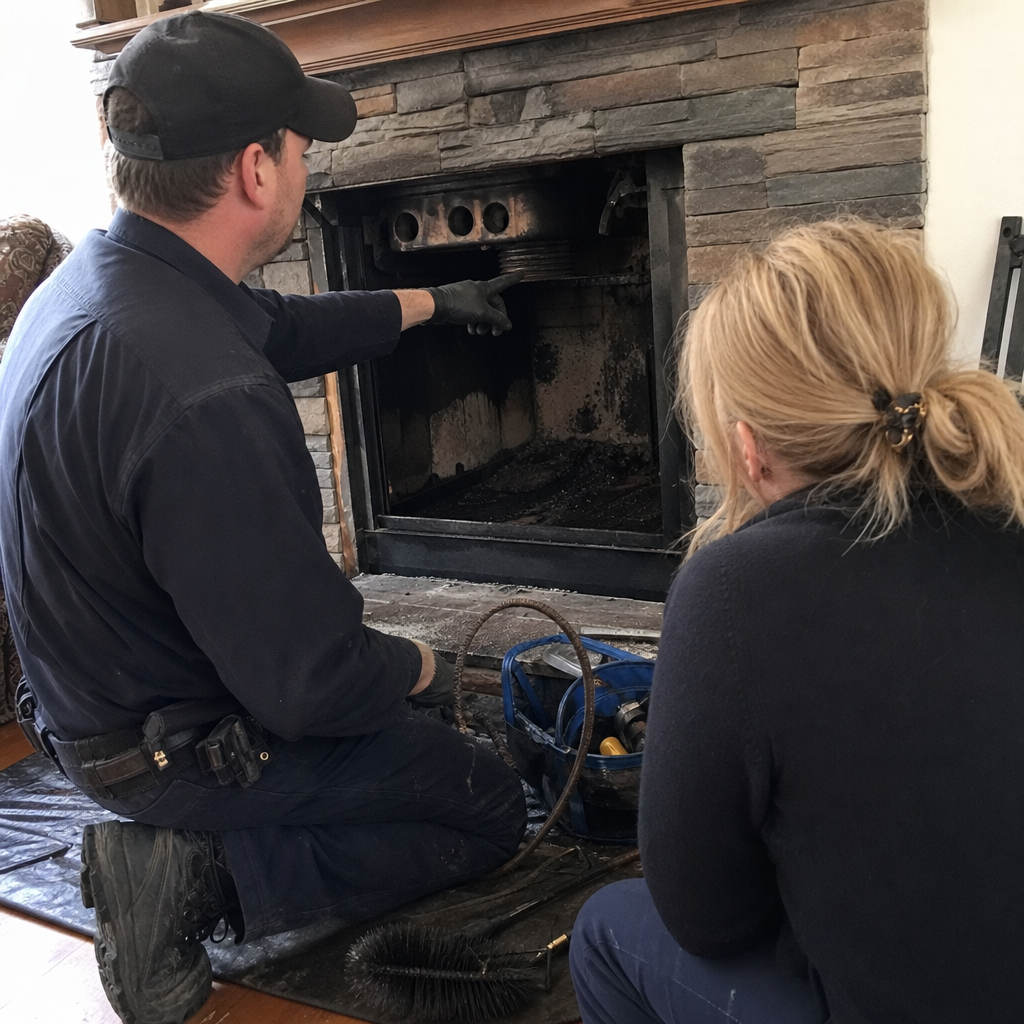
Charles identifies the creosote stage during every initial inspection and explains the appropriate method before any work begins. If your chimney has Stage 3, we’ll show you. We’ll explain why standard sweeping won’t solve it. And we’ll quote the chemical treatment and rotary cleaning separately from a basic sweep, because it is a different service at a different investment level — but one that actually removes the fire risk rather than obscuring it.
What Knoxville’s Historic Housing Stock Means for Creosote Risk
Our city’s architectural heritage adds another layer to this conversation. Knoxville’s historic neighborhoods — Fourth & Gill, Old North Knoxville, and Sequoyah Hills where Charles grew up — contain late-19th and early-20th century masonry chimneys, many with original clay flue tiles, deteriorated parging, or fully unlined flues that predate modern IRC standards. These older systems were designed for coal or early wood-burning appliances with different combustion characteristics than modern EPA-certified inserts.
An unlined or deteriorated flue presents two creosote-related problems. First, the masonry itself is more porous and cooler than a modern stainless steel liner, promoting more condensation. Second, any gap or crack in the structure becomes a potential pathway for ignited creosote to reach combustible framing — a scenario that a contained flue fire in a sound liner wouldn’t create.
Mid-century ranch homes across East Knoxville and Fountain City present a different issue: single-story fireplaces with undersized flues built for coal conversion, which perform poorly when homeowners retrofit them for wood burning. The restricted flue diameter creates chronic low-velocity conditions that accelerate creosote accumulation even with properly seasoned fuel.
We inspect for these structural factors during every service call. Sometimes the right answer isn’t just cleaning — it’s a chimney liner installation with professional-grade materials like DuraFlex or HeatShield that restores proper flue dimensions and temperatures for your actual appliance.
Prevention: What Actually Slows Creosote Buildup in Knoxville Conditions
We don’t believe in selling fear. Most creosote accumulation is preventable with habits that don’t cost extra money — just attention. Here’s what we’ve observed working across 17 years and nearly 1,200 homeowner reviews:
- Season your wood properly: For Appalachian hardwoods, that means 12–18 months minimum in a covered, ventilated stack. Use a moisture meter — they’re $20–$40 and eliminate guesswork. Burn only wood below 20% moisture content.
- Build hot, fast fires: A small, intense fire with good air supply burns more completely than a large, smoldering load. Don’t damper down to “make the wood last” — that’s exactly the low-temperature, oxygen-starved condition that produces Stage 2 and 3 creosote.
- Monitor draft during inversions: If smoke backs into your home on calm, clear nights when the valley is cold, your draft is suppressed. Burn smaller, hotter fires those nights, or skip burning until conditions improve.
- Annual inspection regardless of use: Even gas fireplaces produce some condensation and need flue inspection. For wood burners in Knoxville’s conditions, annual sweeping is the minimum; heavy users or those burning self-harvested wood may need mid-season checks.
The freeze-thaw cycling in our winters — temperatures oscillating frequently around freezing rather than holding steady cold — also spalls brick faces and fractures mortar joints faster than in deeper-South cities. Combined with the Tennessee River valley’s elevated humidity driving persistent moisture into masonry, this means crown cracking and cap failure are near-universal findings on Knoxville homes over 30 years old. A compromised crown lets water into the flue, which doesn’t just damage masonry — it keeps the flue cooler and wetter, accelerating creosote condensation.
When to Call a Professional: Red Flags Knoxville Homeowners Shouldn’t Ignore
Some conditions warrant immediate professional inspection rather than waiting for your annual sweep. Call us at (877) 318-5851 if you observe any of the following:
- Black, shiny deposits visible from the firebox looking upward — especially if they appear glassy or enamel-like rather than dusty
- Smoke backing into the room during normal operation, particularly on calm nights when valley inversions are likely
- A sharp, acrid odor from the fireplace even when not in use — this can indicate active creosote off-gassing
- Any past chimney fire, even “small” ones — the thermal shock cracks flue tiles and creates pathways for future ignition
- Popping or crackling sounds from the flue during burning — this is creosote expanding and can precede ignition
Charles handles every inspection personally. You’ll get the most experienced person on your job, not an apprentice dispatched by a franchise. We’ll show you what we find, explain the stage of creosote if present, and recommend the appropriate service — whether that’s a standard Chimney Cleaning & Sweep, a chemical treatment and rotary cleaning for Stage 3, or structural repairs to address underlying conditions.
FAQs
A standard Stage 1 chimney sweep in Knoxville typically runs $150–$250 for a straightforward cleaning on a regularly maintained system. Stage 2 removal with additional mechanical time generally falls in the $250–$400 range. Stage 3 glazed creosote requiring chemical pretreatment and rotary mechanical cleaning starts around $400–$650 depending on deposit thickness, flue height, and accessibility. We inspect first and quote exact pricing before any work begins — call (877) 318-5851 for a free estimate.
Stage 1 soot accumulation can be addressed with proper brushes and rods if you have safe roof access and understand flue construction — though we still recommend professional inspection to catch liner cracks or structural issues you won’t see from the firebox. Stage 2 and especially Stage 3 glazed creosote should not be attempted DIY: the chemical treatments require professional-grade products and application knowledge, and rotary mechanical systems operated incorrectly can destroy clay flue tiles or damage stainless steel liners. More critically, undiagnosed liner damage behind creosote deposits creates fire risks that no amount of surface cleaning addresses. For anything beyond light Stage 1 dust, we recommend professional service.
The National Fire Protection Association recommends annual inspection for all chimney systems, with cleaning frequency determined by creosote accumulation rate rather than calendar alone. In Knoxville’s specific conditions — Appalachian hardwood burning, potential for under-seasoned self-harvested wood, and valley inversions that suppress draft — we find that wood-burning homeowners typically need annual sweeping at minimum, and those burning self-harvested fuel or operating older masonry systems may need mid-season inspection. Gas fireplace flues should be inspected annually for debris and condensation buildup even though they produce minimal creosote. Nearly 1,200 homeowners reviewed our work, and the most common feedback from repeat clients is that annual professional inspection caught problems they wouldn’t have identified themselves.
Annual Stage 1 maintenance is significantly less expensive than deferred Stage 3 remediation — typically $150–$250 yearly versus $400–$650 or more for glazed deposit removal, not counting potential liner damage or structural repairs that prolonged neglect can necessitate. More importantly, annual cleaning eliminates the fire risk interval: a chimney with progressing Stage 2 or 3 creosote is a latent fire hazard every time it’s used. The homeowners who invest in consistent maintenance avoid both the higher costs of heavy remediation and the safety exposure of operating a compromised system. Call (877) 318-5851 to schedule — estimates are free, and we’ll show you exactly what stage your flue is in.
If you’d rather have it looked at, Titan Chimney Cleaning Service Knoxville offers a no-pressure assessment in Knoxville — call (877) 318-5851.
Written by Charles Rodriguez, Owner & Lead Technician at Titan Chimney Cleaning Service Knoxville, serving Knoxville, TN.