
Signs Your Chimney Needs Cleaning in Knoxville, TN — And the Quiet Warnings Most Homeowners Miss
The most reliable signs your chimney needs cleaning are a fire that’s harder to start than usual, smoke haze appearing within 10 minutes of lighting, and wood burning hotter and shorter than normal — all indicators of creosote narrowing your flue before visible backup occurs. In Knoxville’s Tennessee Valley basin, where temperature inversions from surrounding Appalachian ridges suppress chimney draft through fall and early winter, these pre-symptom warnings show up earlier and more aggressively than in flatter terrain. If you’re seeing any of these patterns, call Titan Chimney Cleaning Service Knoxville at (877) 318-5851 — Charles handles inspections personally and will tell you straight whether you need a sweep or not.

Why the Usual “Signs” Lists Fail Knoxville Homeowners
By the time you smell smoke in your living room or see a dark stain creeping across your firebox, your chimney isn’t warning you it needs cleaning — it’s telling you it needed cleaning three fires ago. Most articles list the same five textbook symptoms: visible soot, smoke backup, a strong odor, a damper that sticks, and debris falling into the fireplace. All five require the homeowner to already have a problem they can detect with their senses.
We’ve spent 17 years on Knoxville rooftops, and the chimneys that scare us aren’t the ones where owners noticed smoke. They’re the ones where nothing seemed wrong until a flue fire cracked a liner or ignited creosote behind a damper. Charles Rodriguez, our owner and lead technician, grew up in Sequoyah Hills and learned this trade climbing ladders on homes from Fourth & Gill to Corryton. The pattern he sees repeatedly: homeowners wait for the obvious sign, and the obvious sign is already a late-stage symptom.
The more useful approach for this market is identifying what happens before the textbook warnings — the subtle shifts in how your fire behaves that indicate creosote buildup is already restricting your flue. These pre-symptom indicators are especially critical in Knoxville because our local burning patterns and housing stock accelerate creosote accumulation beyond what generic advice accounts for.
Three Pre-Symptom Indicators Specific to Knoxville Conditions
Slower Fire Startup After Cold Nights
Knoxville sits in a basin ringed by Sharp’s Ridge to the north and the Cumberland Plateau escarpment to the northwest. This topography produces frequent atmospheric temperature inversions in fall and early winter — layers of cold air trapped under warmer air that suppress the natural draft your chimney relies on.
When you try to light a fire on a morning after a cold night and the kindling smolders longer than usual, or the flame struggles to establish upward draw, many homeowners blame the inversion alone. Sometimes it is just the weather. But if this pattern persists across multiple cold mornings, especially on days when neighboring chimneys are drafting normally, the likely cause is partial flue blockage from creosote narrowing the passage. The inversion exposes an existing restriction; it doesn’t create one.
What to check: Note how long it takes from match to established flame on cold mornings versus milder days. A consistent 3–5 minute difference that worsens over a season suggests buildup, not just weather.
Visible Haze Within 10 Minutes of Lighting
This is the indicator Charles flags most often during inspections in Knoxville homes. Not thick smoke — a faint haze, sometimes visible only when sunlight angles through a window, that appears within the first 10 minutes of a fire. Homeowners frequently dismiss it as “the fireplace warming up” or assume their damper isn’t open fully.
In our experience, this haze signals Stage 2 creosote: a tar-like, crunchy layer that adheres to flue walls and reduces cross-sectional area without fully blocking it. The fire still drafts, but incompletely — combustion gases linger in the firebox longer than they should, producing that subtle haze before the flue temperature rises enough to establish strong draw. Left unaddressed, Stage 2 progresses to glazed creosote, which is significantly harder to remove and far more combustible.
Fire Burns Hotter and Shorter Than Usual
A fire that flares brightly then dies quickly, consuming logs faster than normal, often indicates glazed creosote igniting in brief, low-temperature burns. This isn’t your wood “catching well” — it’s creosote deposits acting as unintended accelerant. The fire feels hotter to your face, logs disappear faster, and you’re left with more ash relative to heat output.
This pattern is particularly common in Knoxville’s exurban communities — Powell, Corryton, the Norris Lake corridor — where homeowners harvest their own firewood from surrounding timber tracts. The wood burns; it just hasn’t seasoned long enough. Moisture content in under-dried Appalachian hardwood runs high enough to double creosote accumulation rates compared to properly seasoned fuel. If you’ve burned self-harvested wood within the last 18 months, treat that as an automatic trigger for inspection regardless of other symptoms.
What Creosote Actually Looks Like When You Check
We tell homeowners to shine a flashlight up past the damper into the flue throat — not because we’re encouraging DIY inspection, but because knowing what you’re looking at helps you decide whether to call. Here’s what you’ll see at each stage:
- Stage 1: Fine, powdery black soot that brushes off easily, like charcoal dust. This is normal after a season of use and sweeps clean readily.
- Stage 2: Crunchy, irregular flakes that look like burnt cornflakes or shattered tar. They break away with some pressure but leave a residue. This requires mechanical brushing — a Chimney Cleaning & Sweep with proper equipment.
- Stage 3: Glassy, hardened glaze — shiny in sections, ranging from dark brown to black. It feels slick and dense, like obsidian. This cannot be brushed out with standard equipment; it requires specialized removal or, in severe cases, liner replacement using professional-grade materials.
Charles has pulled Stage 3 glaze an inch thick from flues in homes where owners reported “no problems.” A clean chimney isn’t a luxury — it’s just what stands between your fireplace and your ceiling.
The Historic Home Factor: Fourth & Gill, Old North Knoxville, and Sequoyah Hills
Knoxville’s historic neighborhoods contain late-19th and early-20th century masonry chimneys, many with original clay flue tiles. If your home in Fourth & Gill, Old North Knoxville, or Sequoyah Hills is over 80 years old and still has its original liner, the absence of visible symptoms is not reassurance — it’s a false negative.
Clay tile liners in this vintage frequently develop concealed cracks that don’t produce visible smoke signs until a serious flue fire occurs. The crack vents combustion gases into the chimney wall cavity rather than the room, so you smell nothing, see nothing, and assume all is well. Meanwhile, creosote seeps into the masonry, acidic condensation accelerates deterioration, and the structural integrity degrades.
For these homes, we recommend CSIA-standard Level 2 inspection — involving video scanning of the flue interior — regardless of apparent performance. Charles performs these inspections personally and will show you the footage. We’ve found cracked tiles hidden behind seemingly functional dampers, gaps at mortar joints that would never show smoke, and once, in a Sequoyah Hills home built in 1923, a fully detached liner section resting on the smoke shelf like a ticking clock.
When liner damage is found, we specify replacement using professional materials — DuraFlex stainless liners for relining, HeatShield for resurfacing sound but gapped tile, Olympia Chimney and Gelco components for cap and connection work. These aren’t hardware-store workarounds; they’re the materials we trust on our own families’ chimneys.
Knoxville’s Climate Reality: Why “Annual” Doesn’t Mean “Wait and See”
Our winters oscillate frequently around the freezing mark rather than holding steady cold. This aggressive freeze-thaw cycling spalls brick faces and fractures mortar joints faster than in deeper-South cities. Meanwhile, the Tennessee River and its TVA impoundments elevate ambient humidity throughout the valley, driving persistent moisture into chimney masonry.
The result: crown cracking and cap failure are near-universal findings on Knoxville homes over 30 years old. A cracked crown lets water into the flue, where it mixes with creosote to form acidic compounds that accelerate liner deterioration. You won’t see this from your living room. You’ll just notice, eventually, that your fires don’t draw like they used to — and by then, you’re looking at repair work beyond a standard sweep.
Mid-century ranch homes across East Knoxville and Fountain City present a different issue: single-story fireplaces with undersized flues built for coal conversion. When homeowners retrofit these for wood burning without verifying flue sizing, the already-marginal draft performance means creosote accumulates faster and symptoms appear sooner. If your ranch home’s fireplace was “converted” by a previous owner and you’ve never had the flue dimensions checked, that’s pre-symptom information worth having.
When to Schedule vs. When to Call Urgently
| Indicator | Recommended Action | Typical Timeline |
|---|---|---|
| Stage 1 soot visible; normal fire behavior | Schedule routine sweep | Within 2–4 weeks |
| Stage 2 flakes; haze on startup; slower cold-weather lighting | Schedule priority sweep + Level 1 inspection | Within 1 week |
| Stage 3 glaze; hot/short burns; any smoke backup | Call immediately — potential fire hazard | Same day or next day |
| Self-harvested wood burned within 18 months; no other symptoms | Schedule inspection to assess accumulation rate | Within 2 weeks |
| Home over 80 years old with original clay liner; no symptoms | Schedule Level 2 inspection with video scan | Within 1 month |
What Titan’s Inspection Actually Involves
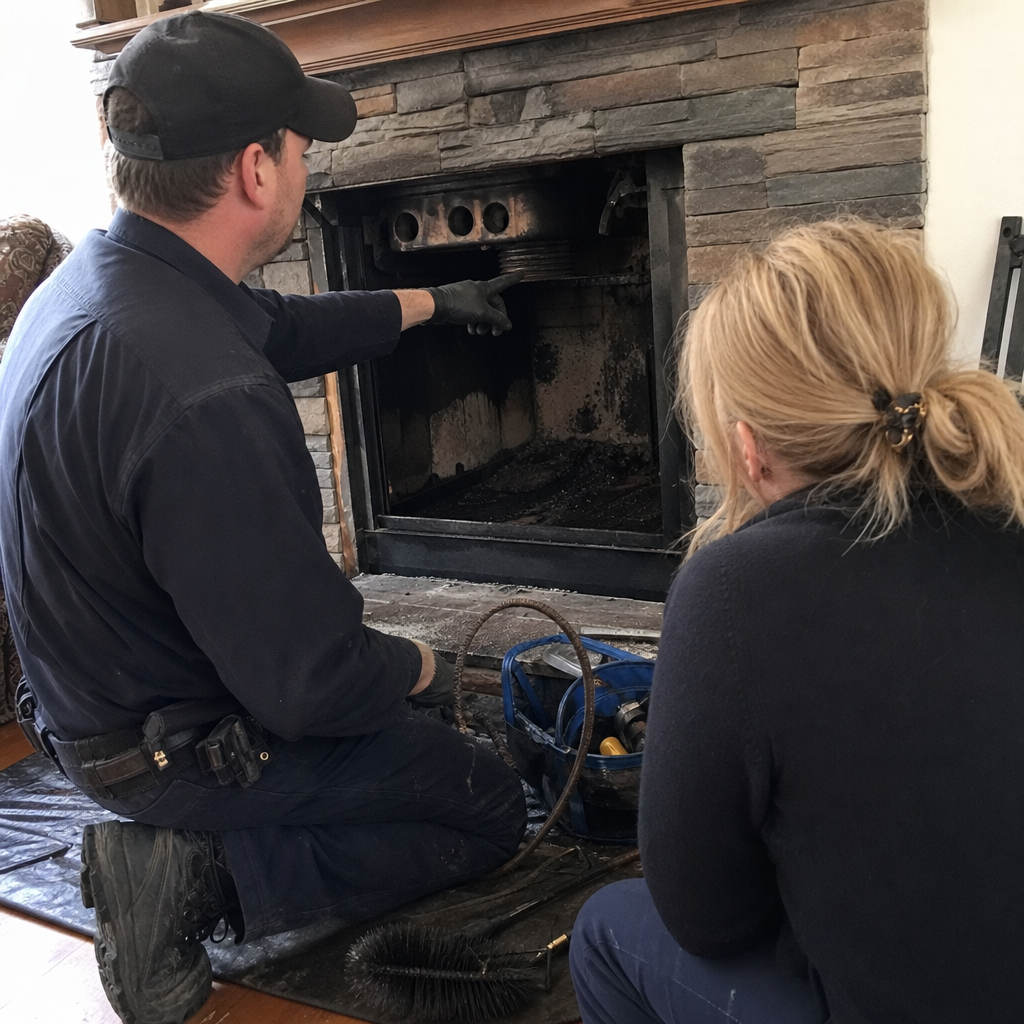
Charles handles every inspection personally — not an apprentice, not a subcontractor. Nearly 1,200 homeowners have reviewed this approach at 4.9 stars, and the consistent feedback we hear is that people appreciate being told when work isn’t needed.
Our Level 1 inspection covers accessible portions of the chimney exterior, interior, and connections — appropriate for chimneys with no changes in use or known problems. Level 2 adds video scanning of the flue interior, required for real estate transactions, after chimney fires, or for historic homes with original liners. We do not perform Level 3 (destructive inspection) unless structural damage is suspected; when needed, we coordinate with structural assessment protocols.
Charles will tell you plainly what he finds, including when the flue is clean and a sweep isn’t needed yet. The business model is repeat customers, not one-time upsells. We’ve had homeowners call us back three years running for an inspection that resulted in “you’re good this year” — and that’s exactly how it should work.
FAQs
A standard chimney sweep and Level 1 inspection in Knoxville typically runs $175–$275, depending on roof access, flue configuration, and creosote stage. Level 2 inspection with video scanning adds $100–$150. If Stage 3 glazed creosote requires specialized removal, or if liner repair with HeatShield or DuraFlex materials is needed, we’ll quote that separately before any work proceeds — estimates are always free. Call (877) 318-5851 for an exact quote on your specific chimney.
You can remove light Stage 1 soot from the firebox and smoke shelf with proper brushes, but we don’t recommend DIY flue cleaning for several reasons specific to Knoxville conditions. Our humidity-driven moisture issues mean creosote often bonds more aggressively than in drier climates; without rotary equipment and proper vacuum containment, you’re likely to leave significant buildup and spread fine particulate through your home. More critically, you’re not equipped to evaluate liner condition, crown integrity, or draft performance — the factors that actually determine whether your chimney is safe to use. For the cost of rental equipment and your time, professional service with documented inspection is the better value. Call (877) 318-5851 if you’d rather have it done right.
Resurfacing a sound but gapped clay tile liner with HeatShield typically costs 40–60% less than full stainless steel relining with DuraFlex, but it’s only appropriate when the tile structure is intact. If tiles are cracked, displaced, or missing sections, replacement is the only safe option — and delaying it risks flue gas leakage into wall cavities, carbon monoxide exposure, or structural fire. Charles will show you the video scan and explain which category your liner falls into; we’ve saved homeowners money with HeatShield where appropriate and refused to apply it where replacement was clearly needed. The cheapest option is the one that doesn’t require a second visit or emergency call. Call (877) 318-5851 for an assessment.
The NFPA 211 standard calls for annual inspection, with cleaning frequency determined by use and fuel type. In practice, Knoxville’s combination of humidity-accelerated creosote bonding, frequent temperature inversions that stress draft performance, and widespread use of self-harvested hardwood means many local homeowners need sweeping more often than the national average — sometimes twice per season for heavy users with marginal wood seasoning. If you burn more than three times weekly during heating season, or if you’ve burned any self-harvested wood within 18 months, treat annual inspection as a minimum, not a default. Call (877) 318-5851 and we’ll help you establish an appropriate schedule based on your actual burning pattern.
What to Do If You’re Seeing Warning Signs Now
If you’ve noticed slower startup on cold mornings, haze within 10 minutes of lighting, or fires that burn hotter and shorter than they should, your chimney is already telling you something. The question is whether you’ll listen before the symptom becomes a problem.
Charles Rodriguez, Owner & Lead Technician at Titan Chimney Cleaning Service Knoxville, handles every inspection personally. With 17 years of chimney-only experience and nearly 1,200 verified reviews, he’s the technician other companies call when they’ve missed something — and he’d rather find your flue clean than find damage that could have been prevented.
If you’d rather have it looked at, Titan Chimney Cleaning Service Knoxville offers a no-pressure assessment in Knoxville — call (877) 318-5851 for a free estimate.
Written by Charles Rodriguez, Owner & Lead Technician at Titan Chimney Cleaning Service Knoxville, serving Knoxville, TN.