
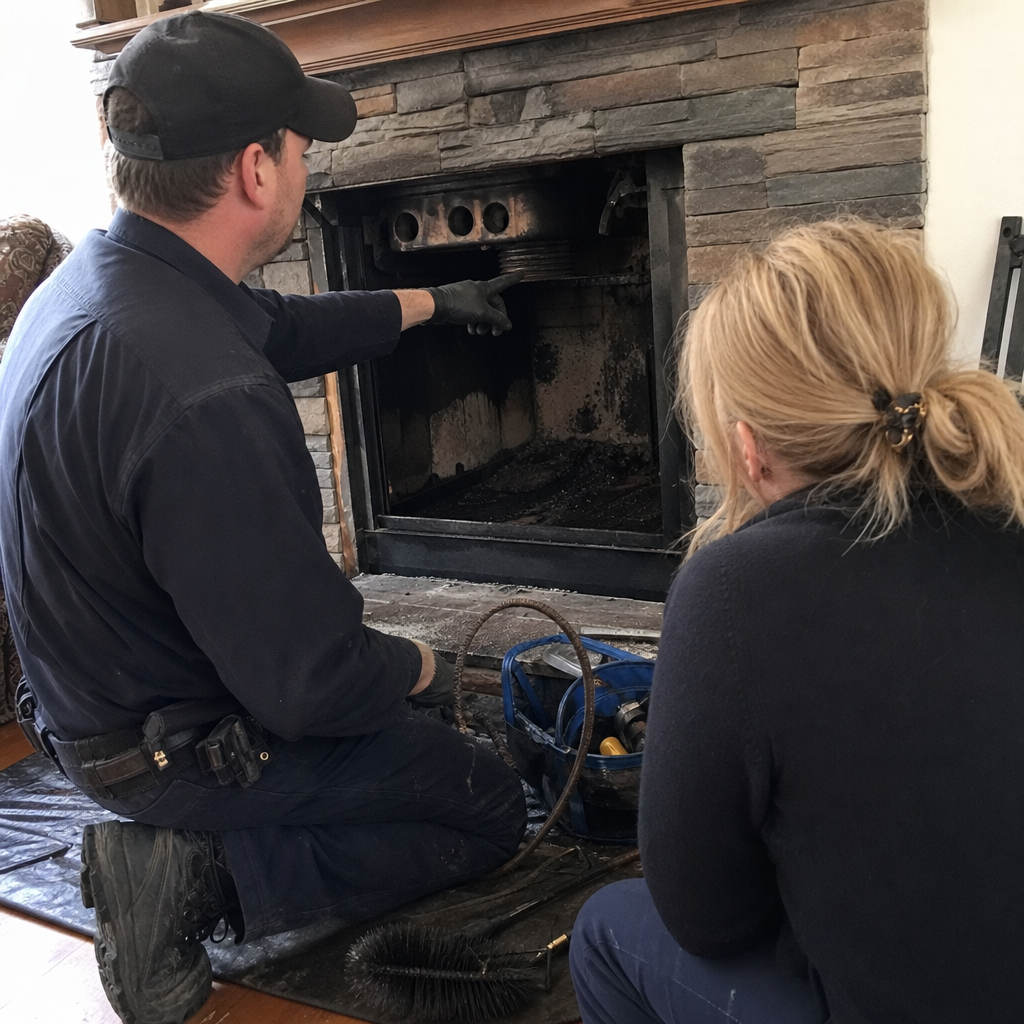
How Often Should You Clean Your Chimney in Knoxville? It Depends on What You Burn and How Hard You Burn It
Most Knoxville homeowners should have their chimney swept after every 1.5 to 2 cords of wood burned, which typically works out to once annually for light users and twice per season for heavy rural burners in Powell or Corryton. Gas fireplace inserts need an annual Level 1 inspection but rarely require cleaning unless debris or animal intrusion has occurred. For a precise answer on your specific system, call Titan Chimney Cleaning Service Knoxville at (877) 318-5851 — Charles Rodriguez handles every assessment personally.

The annual chimney sweep rule was written for the average American fireplace. The average American fireplace doesn’t sit in the Tennessee Valley, burning Appalachian oak that’s been drying since September. After 17 years on Knoxville rooftops, we’ve learned that the National Fire Protection Association’s blanket “at least once per year” guidance systematically undercounts for homeowners burning heavy loads of local hardwood and overcounts for gas insert owners who fire theirs up twice a winter. The honest answer in this market isn’t about what month it is — it’s about your specific burn profile, your wood source, and how Knoxville’s unique geography affects what happens inside your flue.
Why Knoxville’s Geography Changes the Math
Knoxville sits in the Tennessee Valley basin, ringed by Appalachian ridges — Sharp’s Ridge to the north, the Cumberland Plateau escarpment to the northwest — that produce frequent atmospheric temperature inversions in fall and early winter. These inversions suppress chimney draft on days when a high-pressure system settles over the valley and traps cooler air beneath a warm layer aloft. The result: lower combustion temperatures, incomplete burns, and creosote deposits that accumulate faster than the homeowner realizes.
We’ve stood in living rooms across Sequoyah Hills and Fountain City where the fireplace “worked fine last year” but is now pouring smoke back into the house on a still October morning. The chimney isn’t broken — the atmospheric conditions are. But those same conditions mean the flue has been running cooler than designed, and that 1/8-inch deposit threshold the Chimney Safety Institute of America warns about? It’s been crossed weeks ago.
Add to this the humidity factor. The Tennessee River and its TVA impoundments keep ambient moisture elevated throughout the valley year-round. That moisture drives into chimney masonry, accelerates crown cracking, and combines with creosote to form acids that deteriorate flue liners faster than in drier climates. A clean chimney isn’t a luxury — it’s just what stands between your fireplace and your ceiling.
Three Real Knoxville Burn Profiles: How Often Each Actually Needs Cleaning
After nearly 1,200 homeowner reviews and 17 years of chimney-only work in this market, we’ve distilled Knoxville’s burn patterns into three profiles. Your household likely fits one of them.
Profile 1: The Light Urban Burner (Fourth & Gill, Old North Knoxville, Downtown Condos)
You’re burning 30 to 40 fires per season, mostly weekend ambiance, using kiln-dried hardwood from a local supplier or bundled retail wood. Your flue stays relatively dry, your fires are hot and brief, and your creosote buildup is minimal — typically a light, sooty layer that’s easily brushed.
Our recommendation: Annual sweep before the season starts, usually in September or October. A single Chimney Cleaning & Sweep appointment suffices. We’ve found that homeowners in these historic neighborhoods with original clay flue tiles — common in late-19th and early-20th century masonry chimneys — benefit especially from this rhythm, since their flue surfaces are more porous and trap deposits differently than modern liners.
Profile 2: The Moderate Suburban Burner (Fountain City, East Knoxville, North Hills)
You burn mixed purchased and self-split wood, maybe 60 to 80 fires per season, sometimes running the fireplace consecutive evenings during cold snaps. Your wood source varies — some properly seasoned, some questionable. You’re the profile we see most often with stage 2 creosote: flaky, hardened deposits that require more than a standard brush.
Our recommendation: Annual sweep before season, plus a mid-season spot check in January or February. Charles has pulled bird nests packed so tight from Fountain City chimneys they’re essentially fire starters, and the freeze-thaw cycling in this part of Knoxville — winters oscillating around freezing rather than holding steady cold — spalls brick and fractures mortar, creating new entry points for moisture and animals between scheduled sweeps.
Profile 3: The Heavy Rural Burner (Powell, Corryton, Norris Lake Corridor)
You’re burning 3+ cords per season, harvesting your own mixed hardwood from surrounding timber tracts, and running a wood stove or insert as primary or significant supplemental heat. This is where the NFPA’s annual guidance falls shortest. We’ve found chimneys in these exurban communities choked with heavy glazed creosote — third-degree, glassy, nearly impossible to remove with standard brushing — because homeowners burned self-harvested wood before it properly seasoned.
Our recommendation: Sweep every 1.5 to 2 cords burned, regardless of calendar date. For a 3-cord household, that’s twice per season minimum. When we encounter glazed creosote in these systems, we deploy mechanical removal or, in severe cases, recommend a HeatShield flue liner restoration or DuraFlex stainless steel liner installation to restore safe function. The geographic fault line here is real: this pattern of self-harvested, under-dried mixed hardwood burning is essentially absent in Knoxville’s urban core.
The Concrete Threshold: When “Soon” Becomes “Now”
Calendar recommendations are useful starting points, but the physical reality inside your flue overrides everything. Here’s what determines whether cleaning is actually overdue:
- 1/8 inch of deposit: When a mirror or flashlight inspection of the smoke chamber shows more than 1/8 inch of creosote buildup, cleaning is required regardless of when the last sweep occurred. This is the CSIA’s actionable standard, not a suggestion.
- Any glazed surface: Third-degree creosote appears shiny, black, and tar-like. It reflects light like obsidian. If you see it, your chimney is a known fire hazard — stage 3 creosote ignites at lower temperatures and burns with explosive intensity.
- Draft performance changes: Smoke backing into the room, difficulty starting or maintaining a fire, or unusual odors during operation all signal restricted airflow from deposit buildup or animal/debris obstruction.
- Visible debris or animal activity: Nesting materials, droppings, or audible animal presence require immediate inspection and cleaning, even if the flue was swept last month.
Charles grew up in Sequoyah Hills and has never had much interest in leaving — this city is home, plain and simple. Over 17 years of working Knoxville rooftops, he’s become the guy neighbors call when another company has already missed something: creosote buildup behind a damper, a cracked flue liner nobody spotted, a bird nest packed so tight it’s a fire waiting to happen. That hands-on experience means when he inspects your system, he’s comparing it against hundreds of similar Knoxville chimneys, not a textbook diagram.
Gas Fireplace Owners: You’re Different, and That’s Okay
One of the most common points of confusion we encounter is conflating gas and wood cleaning needs. A gas appliance fireplace typically needs a Level 1 inspection annually — checking for proper venting, debris obstruction, and component function — but cleaning only if a debris or animal intrusion event has occurred.
Gas burns clean. It doesn’t produce creosote. The flue stays largely clear. What gas systems do need is verification that the venting pathway remains unobstructed, that moisture hasn’t deteriorated the liner (critical in Knoxville’s humid valley environment), and that no critter has decided your warm flue makes excellent winter housing.
We’ve had homeowners in Fourth & Gill and Sequoyah Hills request unnecessary gas flue “cleanings” based on the annual sweep reminder from their utility company or a franchise sweep operation. That’s wasted spend. Get the inspection. Clean only if there’s something to clean.
What Knoxville’s Housing Stock Means for Your Cleaning Schedule
The age and construction of your chimney significantly affects how often it needs attention:
- Historic masonry (Fourth & Gill, Old North Knoxville, Sequoyah Hills): Original clay flue tiles, deteriorated parging, or fully unlined flues that predate modern IRC standards. These systems accumulate deposits differently and may need more frequent inspection, especially if retrofitted for wood burning from original coal or gas configuration.
- Mid-century ranch (East Knoxville, Fountain City): Single-story fireplaces with undersized flues built for coal conversion. When homeowners retrofit these for wood burning, the flue runs cooler than designed, accelerating creosote formation. We’ve replaced undersized flues with properly dimensioned Olympia Chimney liner systems to solve this permanently.
- Post-1980 construction: Generally better flue sizing and modern clay or metal liners, but still vulnerable to Knoxville’s humidity-driven crown and cap deterioration. Gelco cap installations are a routine part of our maintenance work on these homes.
The freeze-thaw cycling peculiar to Knoxville — winters that swing above and below freezing rather than holding steady — spalls brick faces and fractures mortar joints faster than in deeper-South cities. Combined with persistent valley humidity, this makes crown cracking and cap failure a near-universal finding on homes over 30 years old. A cracked crown lets water into the flue system, where it mixes with creosote to form corrosive acids that damage liners and accelerate deposit buildup. Cleaning frequency means little if the chimney’s physical envelope is compromised.
What a Professional Sweep Actually Costs and Includes
Pricing transparency matters. Here’s what Knoxville homeowners can expect when Titan Chimney Cleaning Service Knoxville handles the work — with Charles Rodriguez personally performing or directly supervising every job:
| Service | Typical Range | What’s Included |
|---|---|---|
| Standard Chimney Sweep (light to moderate buildup) | $175 – $275 | Full flue brushing, smoke chamber cleaning, firebox inspection, damper check, exterior crown/cap visual, written condition report |
| Heavy Creosote Removal (stage 2–3) | $300 – $450 | Mechanical or chemical removal of hardened/glazed deposits, extended cleaning time, detailed photo documentation |
| Level 1 Inspection (gas or minimal-use wood) | $125 – $195 | Visual inspection of accessible components, venting verification, operational test, written findings |
| Mid-Season Spot Check | $95 – $150 | Targeted inspection and light cleaning if needed, ideal for Profile 2 burners between full sweeps |
These ranges reflect Knoxville’s market specifically — not national averages, not franchise pricing from out-of-state operations. We use professional-grade materials from DuraFlex, HeatShield, Gelco, and Olympia Chimney when repairs or liner work follows cleaning, ensuring the full chimney system is addressed under one roof with no referral gaps.
FAQs
A standard chimney sweep in Knoxville typically runs $175 to $275 for light to moderate buildup, while heavy creosote removal ranges from $300 to $450 depending on accessibility and deposit severity. Gas fireplace inspections are generally $125 to $195. Call (877) 318-5851 for an exact quote — estimates are free, and Charles handles every assessment personally.
DIY chimney cleaning kits cost $50 to $150 but rarely remove stage 2 or 3 creosote effectively and provide no inspection of the flue liner, crown, or structural condition. Given that chimney fires cause over $125 million in U.S. property damage annually and Knoxville’s humidity-accelerated deterioration hides problems from untrained eyes, professional service pays for itself in hazard identification alone. We’ve been called to homes where a homeowner’s “clean” chimney still contained dangerous glazed deposits behind a damper they couldn’t access.
During peak season (September through February), we typically schedule within 3 to 5 business days for non-urgent sweeps and offer same-day or next-day response for active smoke backup, suspected blockages, or post-chimney-fire assessment. Off-season months often allow next-day scheduling. Call (877) 318-5851 — we’ll tell you honestly whether your situation needs immediate attention or can wait for routine booking.
Inspect your firebox and lower flue with a flashlight: if you see more than 1/8 inch of black buildup, any shiny glazed deposits, or if your fires have been smoking back, difficult to start, or producing unusual odors, cleaning is overdue regardless of calendar. For gas fireplaces, schedule an inspection if you haven’t had one in 12 months or if you notice debris, animal sounds, or venting changes. When in doubt, a quick call to (877) 318-5851 gets you Charles’s direct assessment — no charge for the conversation.
Key Takeaways for Knoxville Homeowners
- Light urban burners (30–40 fires/year, kiln-dried wood): Annual sweep before season
- Moderate suburban burners (60–80 fires/year, mixed wood sources): Annual sweep plus mid-season spot check
- Heavy rural burners (3+ cords/year, self-harvested wood): Sweep every 1.5–2 cords burned, calendar-independent
- Gas fireplace owners: Annual Level 1 inspection, cleaning only if debris or animal intrusion occurred
- The 1/8-inch deposit threshold and any glazed creosote override all schedule recommendations
- Knoxville’s valley inversions and humidity accelerate problems that flatland guidance doesn’t account for
If you’d rather have it looked at than guess, Titan Chimney Cleaning Service Knoxville offers a no-pressure assessment anywhere in the Knoxville area — Charles Rodriguez, Owner & Lead Technician, handles every evaluation personally. Call (877) 318-5851 for a free estimate.
Written by Charles Rodriguez, Owner & Lead Technician at Titan Chimney Cleaning Service Knoxville, serving Knoxville, TN.